USA stocking retailer 60 capsules · two a day · 30 days 10 of 10 amounts printed · no blend 677 mg of actives, every milligram itemised Read the panel

01 The bottle, in one line

Sciatica Pro+: support for sciatic comfort, with every amount printed on the label

  • 60 capsules a bottle
  • 2 capsules a day
  • 30 days a bottle
  • 10 of 10 amounts printed
  • 400 mg alpha lipoic acid
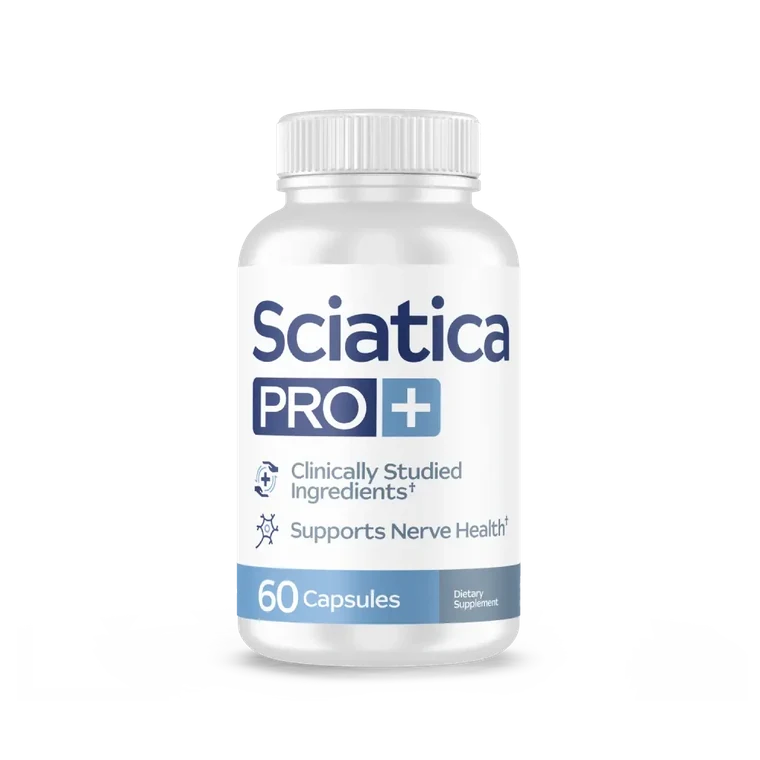
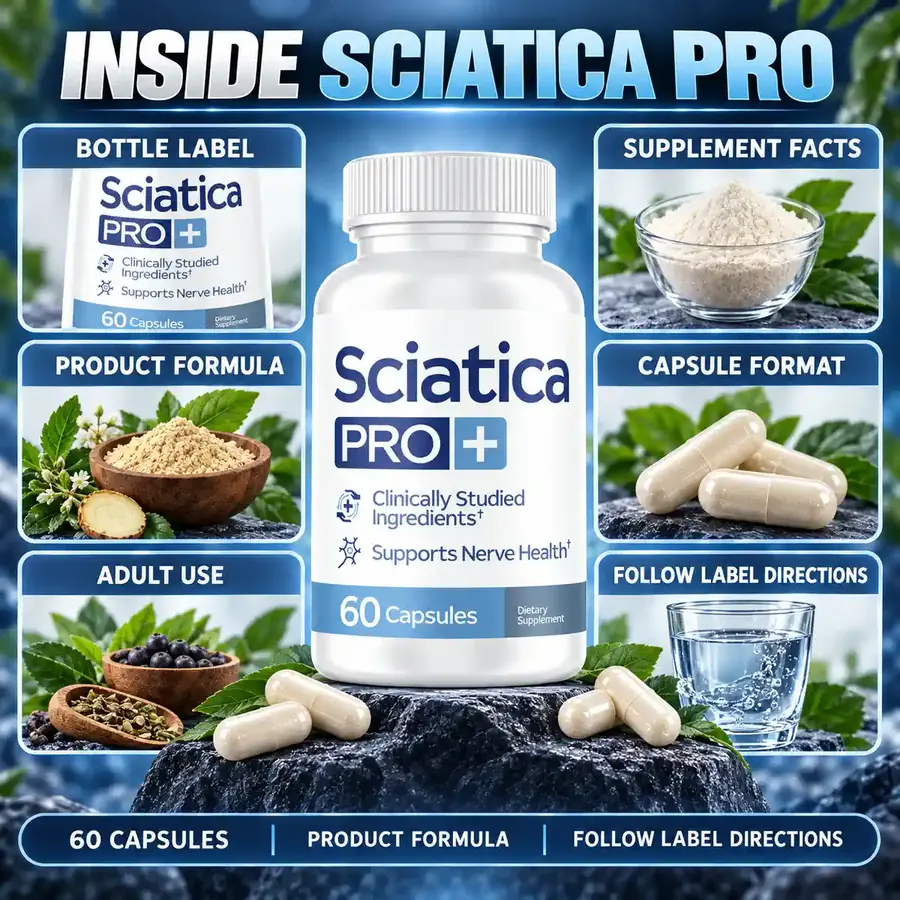
A white bottle of Sciatica Pro, 60 capsules, photographed against white

2 capsules a day

Sciatica Pro+ is a capsule supplement made to support sciatic comfort. The label dose is two capsules daily with water, so a 60-capsule bottle lasts 30 days. All ten ingredients carry a printed amount, from 2 mcg of vitamin B12 up to 400 mg of alpha lipoic acid. It is not a pain medicine, and price and guarantee are set at checkout.

USA stocking retailer · the ten ingredients · when to call someone instead · the pack sizes

  1. 20 mcgVitamin D3
  2. 1.7 mgVitamin B6
  3. 383 mcg DFEFolate
  4. 2 mcgVitamin B12
  5. 400 mgAlpha lipoic acid
  6. 150 mgBenfotiamine
  7. 50 mgAcetyl L-carnitine
  8. 25 mgAshwagandha
  9. 25 mgBroccoli
  10. 25 mgTurmeric

One tick for each of the ten ingredients, in panel order. Tick height is logarithmic, because these amounts run from 2 mcg to 400 mg.Ten rows · ten printed amounts · 677 mg of declared actives

10 of 10amounts printed on the panel
677 mgdeclared actives a serving
30days in every 60-capsule bottle
shown at the checkout one bottle, read from the live checkout
Card logos from the checkout page GMP certified mark FDA registered facility mark Made in USA mark The seals supplied with this product, and the four printed on the label itself: what each one means.
Money-back gold roundel
Money-back guarantee
FDA registered blue seal
FDA registered
Made in USA blue roundel
Made in USA
GMO free green roundel
GMO free
Natural ingredients green seal
Natural ingredients

02 Before anything about the product

Some back and leg pain is not a shopping question

MedlinePlus names the symptoms that mean stop reading and contact a provider. They go here, at the top, in its wording.

Some back and leg pain is not a shopping question. MedlinePlus Medical Encyclopedia, on sciatica, under When to Contact a Medical Professional, prints the instruction as “Contact your provider right away if you have:” and then lists nine symptoms. All nine are below, in MedlinePlus’s own words and in the order it prints them. If any of them describes you, stop reading this site and make the call. Nothing on this page is more important than that, and no supplement is.

  • Unexplained fever with back pain
  • Back pain after a severe blow or fall
  • Redness or swelling on the back or spine
  • Pain traveling down your legs below the knee
  • Weakness or numbness in your buttocks, thigh, leg, or pelvis
  • Burning with urination or blood in your urine
  • Pain that is worse when you lie down, or awakens you at night
  • Severe pain and you cannot get comfortable
  • Loss of control of urine or stool (incontinence)

Those nine are the ones MedlinePlus puts under “Contact your provider right away if you have:” — they are printed here complete and unedited, because a shortened safety list is a worse thing than no safety list. The same page prints a second and slower list under “Also contact your provider if:”: you have been losing weight unintentionally; you use steroids or inject illicit drugs; you have had back pain before, but this episode is different and feels worse; and this episode of back pain has lasted longer than 4 weeks. Those four are reasons to be seen rather than reasons to go now, and the distinction between the two lists is MedlinePlus’s own rather than this desk’s.

This matters more on a site about this product than it would on almost any other. A capsule bought online is a thing you can start taking tonight without telling anybody, and the one cost of that is the weeks it can absorb while a symptom that needed a clinician goes unreported. If you have any of the symptoms above, the correct next step is a provider, today, not a purchase.

03 The condition, before the capsule

What the federal pages say sciatica is

Four MedlinePlus sentences and one from NINDS, quoted rather than summarised. All three named causes are mechanical.

MedlinePlus: “Sciatica is a symptom of a problem with the sciatic nerve, the largest nerve in the body.” Note the word symptom. “When you have sciatica, you have pain, weakness, numbness, or tingling.” “It can start in the lower back and extend down your leg to your calf, foot, or even your toes.” “It’s usually on only one side of your body.” The Medical Encyclopedia adds that the pain “Sciatica pain can vary widely. It may feel like a mild tingling, dull ache, or burning sensation.” and “The pain most often occurs on one side of the body.”

MedlinePlus names three causes: “A ruptured intervertebral disk”, “Narrowing of the spinal canal that puts pressure on the nerve, called spinal stenosis”, and “An injury such as a pelvic fracture.” And then the sentence that should govern every expectation anybody brings to a product in this category: “In many cases no cause can be found.” All three named causes are mechanical — something pressing on a nerve.

Two more sentences from MedlinePlus, and they are the two people search for most. “Sometimes sciatica goes away on its own.” And: “Treatment, if needed, depends on the cause of the problem. It may include exercises, medicines, and surgery.” Read those together and the shape of the thing is clear: the course varies, improvement without treatment happens, and what is done about it depends on what is causing it. Nothing in that sentence is a capsule, and nothing on this site says otherwise.

NINDS, on approaches outside medicine and surgery: “Research has shown that some complementary health approaches can improve pain in some people. These include acupuncture, chiropractic care, massage therapy, tai chi, and others.” Dietary supplements are not in that list. That is not a finding against them; it is a federal sentence that names five things and does not name a sixth, and it is quoted here because a reader weighing a purchase deserves to see what else the federal record puts in the frame.

Everything the federal pages say about sciatica

04 The product, at a glance

Every amount on this label is printed, and that is the headline

Sixty capsules, two a day, thirty days. Ten ingredients and ten figures, with nothing pooled into a total.

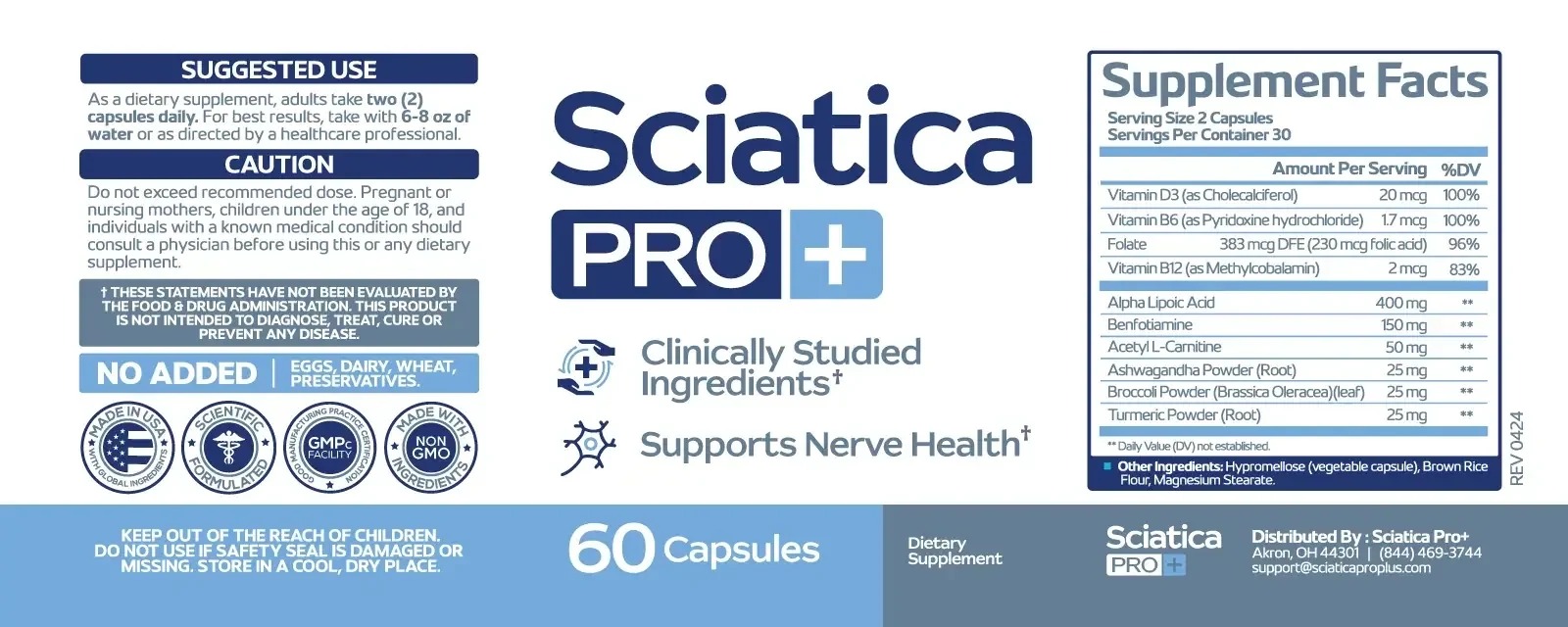
Start with the thing this label does right, because it is unusual enough to lead with. There is no proprietary blend on this bottle. The Supplement Facts panel lists ten ingredients and prints a separate amount for every single one of them: vitamin D3 at 20 mcg, vitamin B6 at 1.7 mg, folate at 383 mcg DFE, vitamin B12 at 2 mcg, alpha lipoic acid at 400 mg, benfotiamine at 150 mg, acetyl L-carnitine at 50 mg, and ashwagandha, broccoli and turmeric powders at 25 mg each. Ten rows, ten figures, no blend line and nothing pooled.

That sounds like a low bar and it is not. A proprietary blend prints one total for a group of ingredients and no figure for any member of it, which means a reader can bound the amounts at best and never state them. This panel asks nobody to infer anything. Every amount on this site is a printed amount, quoted from the photographed panel, which is why you will not find the words derived, at most or capped at anywhere on these pages. It also means every comparison that follows is an honest one: a printed 400 mg can be set beside a studied 600 mg and the arithmetic is simply division.

Product
Sciatica Pro, a dietary supplement
Name on the bottle
“Sciatica PRO +” — the label prints a plus
Form
Capsules. A hypromellose vegetable capsule
Count
60 capsules a bottle
Serving
2 capsules
Servings per container
30
Days per bottle
30, at two capsules a day
Directions on the bottle
“adults take two (2) capsules daily”, with 6-8 oz of water
Timing on the bottle
Not stated — and not stated anywhere else either
Proprietary blend
None. All ten amounts are printed
Ingredients with a printed amount
10 of 10
Declared actives per serving
About 677 mg, every milligram of it itemised
%DV arithmetic
Checked on all four vitamin rows. All four correct
Ingredients with a federal fact sheet
4 of 10 — the four vitamins
Ingredients with a named clinical trial
3 of 10 — all three in diabetic neuropathy
Trials in sciatica
None. No trial cited here studied sciatica
Largest amount
Alpha lipoic acid, 400 mg
Smallest amounts
Vitamin B12, 2 mcg; and three powders at 25 mg each
Painkiller in the formula
None of any kind
Other ingredients
Hypromellose (vegetable capsule), brown rice flour, magnesium stearate
No added
Eggs, dairy, wheat, preservatives — as printed on the label
Country of origin
“MADE IN USA WITH GLOBAL INGREDIENTS”
Distributed by, per the bottle
Sciatica Pro+, Akron, OH 44301
Office and returns, per the pack
New York, NY — a different company
Lot, CoA reference, label revision
SP-26/MY-6297 · SP-6297-26-MY · REV 0424
Price
Not supplied. Read it on the live checkout
Guarantee
Not supplied. “As printed on the live checkout”

One bottle: shown at the checkout60 capsules, two a day, thirty days a bottle. Ten ingredients, ten printed amounts, no proprietary blend.
Order Sciatica Pro

05 The method, drawn

How to read this bottle in six steps

Each step draws itself as you reach it. The whole thing takes about ninety seconds and it works on any supplement label, not just this one.

The front of this bottle carries two claims and the marketing carries ten roundels. Neither is the surface that decides anything. The panel on the back is, and on this product it is unusually good, so the method below is not a hunt for what is hidden — it is six steps for turning ten printed figures into something a buyer can actually weigh.

01

Read the panel, not the front of the bottle

The Supplement Facts panel is the regulated surface and on this product it is also the most complete one. It lists ten ingredients and prints an amount beside every single one of them. Nothing is pooled into a total, so there is nothing to infer and nothing to bound.

10 of 10 printed
02

Divide each amount by its Daily Value

Four rows carry a %DV, and checking them costs four divisions. Vitamin D3: 20 of 20 mcg is 100%. Vitamin B6: 1.7 of 1.7 mg is 100%. Folate: 383 of 400 mcg DFE is 95.8%, printed as 96%. Vitamin B12: 2 of 2.4 mcg is 83.3%, printed as 83%. Four rows, four passes.

4 of 4 correct
03

Do the folate conversion before you trust the folate row

The folate line prints two numbers in two units: 383 mcg DFE (230 mcg folic acid). NIH’s Office of Dietary Supplements gives the factor, and the working is 230 × (400 ÷ 240) = 383.3, which the label rounds to 383. A label that handles a two-unit conversion and then the percentage that depends on it was checked by somebody.

383 mcg DFE
04

Set every printed amount against a studied amount

This is the step the panel makes possible, and it is the whole editorial job on this product. Alpha lipoic acid is 400 mg against the 600 mg its trial called optimal. Benfotiamine is 150 mg against a 300 mg lower arm. Acetyl L-carnitine is 50 mg against 1,500 mg. Two-thirds, one half, one thirtieth.

3 rows, 3 fractions
05

Name the condition each trial was actually run in

All three of those trials were in diabetic neuropathy, which is metabolic nerve damage. MedlinePlus on the condition this product is named after: “Sciatica occurs when there is pressure on or damage to the sciatic nerve.” Different mechanism, different condition. No trial cited anywhere on this site studied sciatica, and untested is the accurate word for that.

0 trials in sciatica
06

Last, look at what is not printed anywhere

Seven of the ten rows have no studied amount for nerve pain to compare with at all. And no price, shipping figure or guarantee length came to this desk, so none is printed here — the seller’s own pack says to print live checkout prices and not to guess, and this site does exactly that. Every money figure on these pages is read at the checkout, where the number is current.

7 rows with nothing to compare

06 The amounts

Ten printed amounts, plotted against what the trials used

Three rows have a studied amount to be measured against and all three fall short of it. The other seven have nothing published to compare them with, and the plot says so.

The second thing to check on any label is whether the percentages agree with the amounts beside them, because that is the cheapest honesty test there is and it takes four divisions. Every %DV on this panel is arithmetically correct. Vitamin D3: the Daily Value is 20 mcg, and 20 divided by 20 is 100%. Vitamin B6: the Daily Value is 1.7 mg, and 1.7 divided by 1.7 is 100%. Folate: the Daily Value is 400 mcg DFE, and 383 divided by 400 is 95.8%, which rounds to the printed 96%. Vitamin B12: the Daily Value is 2.4 mcg, and 2 divided by 2.4 is 83.3%, which rounds to the printed 83%. Four rows, four checks, four passes.

The folate row needs one more step, because it prints two numbers and they are in different units: 383 mcg DFE (230 mcg folic acid). DFE stands for dietary folate equivalents, and it exists because folic acid from a supplement is absorbed better than folate from food, so the two are not interchangeable milligram for milligram. NIH’s Office of Dietary Supplements gives the conversion in one sentence: “240 mcg of folic acid and 400 mcg of folate are both equal to 400 mcg DFE”, which is a factor of 400 divided by 240, or 1.667. So the working is 230 mcg folic acid × (400 ÷ 240) = 383.3, which the label rounds to 383 mcg DFE. That is correct to the milligram, and the 96% beside it follows from it. A label that gets a two-unit conversion right, prints both numbers, and then gets the percentage right as well is a label that was checked by somebody.

RowAs the panel prints it Printed amount against studied amountThe figures
01 Vitamin D3 (as Cholecalciferol)printed with a %DV of 100% 20 mcgno studied amount

No studied amount for nerve pain was supplied for this ingredient.

Printed at 20 mcg, which is 100% of the Daily Value, and the arithmetic checks: 20 divided by 20 is 100%. NIH’s Office of Dietary Supplements gives an RDA of “15 mcg (600 IU)” for adults 19 to 70 and “20 mcg (800 IU)” for 71 and over, with an upper limit of “100 mcg (4,000 IU)” — recommendations, not trial doses. On multiple sclerosis, a disease of the nerves, ODS says “taking vitamin D supplements does not keep symptoms from getting worse or coming back.”

02 Vitamin B6 (as Pyridoxine hydrochloride)printed with a %DV of 100% 1.7 mgno studied amount

No studied amount for nerve pain was supplied for this ingredient.

Printed at 1.7 mg, exactly 100% of the Daily Value. On this one ingredient the absence of a studied amount is a relief rather than a gap. ODS: “taking high amounts of vitamin B6 from supplements for a year or longer can cause severe nerve damage”. The federal upper limit is “100 mg” a day and ODS notes that EFSA “set an upper limit for vitamin B6 of 12 mg per day for all adults”. At 1.7 mg this label is under even the lower European figure by a factor of seven.

03 Folateprinted with a %DV of 96% 383 mcg DFEno studied amount

No studied amount for nerve pain was supplied for this ingredient.

Printed as 383 mcg DFE with 230 mcg of folic acid in brackets, and both steps check out. ODS: “240 mcg of folic acid and 400 mcg of folate are both equal to 400 mcg DFE” — a factor of 1.667, so 230 × (400 ÷ 240) = 383.3, rounded to 383. Then 383 of the “400 mcg DFE” RDA is 95.8%, printed as 96%. The upper limit from supplements and fortified foods is “1,000 mcg”, so this row sits at well under half of it.

04 Vitamin B12 (as Methylcobalamin)printed with a %DV of 83% 2 mcgno studied amount

No studied amount for nerve pain was supplied for this ingredient.

Printed at 2 mcg against an adult RDA of “2.4 mcg”, which is the 83% beside it: 2 divided by 2.4 is 83.3%. ODS gives the honest reason B12 belongs in a conversation about nerves at all: “Vitamin B12 deficiency can damage the nervous system even in people who don’t have megaloblastic anemia.” That is a sentence about deficiency, and whether you are short of it is a blood test rather than a purchase.

05 Alpha Lipoic Acidthe largest row on the panel 400 mg of 600 mgtwo thirds of it

SYDNEY 2: oral doses of 600 mg, 1,200 mg and 1,800 mg once daily for five weeks in 181 patients with diabetic distal symmetric polyneuropathy, in Russia and Israel.

The authors’ conclusion, word for word: “An oral dose of 600 mg once daily appears to provide the optimum risk-to-benefit ratio.” So the printed 400 mg is two-thirds of the dose that trial called optimal, and that trial was in diabetic distal symmetric polyneuropathy rather than in sciatica. Two-thirds is a real fraction of a real studied dose. It is also a fraction, in a different condition.

06 Benfotiaminethe second-largest row 150 mg of 300 mgone half of it

A placebo-controlled trial: 300 mg a day and 600 mg a day for six weeks, 165 patients randomised, all with symmetrical distal diabetic polyneuropathy.

The authors’ conclusion, word for word: “Benfotiamine may extend the treatment option for patients with diabetic polyneuropathy.” Note the two careful words in it, may and diabetic. The printed 150 mg is half the lower of those two arms, in diabetic polyneuropathy rather than in sciatica.

07 Acetyl L-Carnitinethe widest gap on the panel 50 mg of 1,500 mgone thirtieth of it

A Cochrane review of four trials and about 906 participants with diabetic peripheral neuropathy, at 1,500 mg, 2,000 mg and 3,000 mg a day.

The review’s plain-language conclusion, word for word: “We are uncertain whether ALC reduces pain in DPN, as the evidence is sparse and of very low certainty.” So this row is one thirtieth of the lowest dose used in those trials, and those trials were in diabetic peripheral neuropathy rather than in sciatica — and even at thirty times this amount, in the condition that was actually studied, the verdict was uncertainty. The division is one anybody can do: 1,500 divided by 50 is 30.

08 Ashwagandha Powder (Root)printed as powder, no ratio given 25 mgno studied amount

No studied amount for nerve pain was supplied for this ingredient.

Printed at 25 mg with the footnote “** Daily Value (DV) not established.” No federal consumer page supplied to this desk gives one either, so there is no figure to set 25 mg against and this site assigns it no effect. It is present, it is printed, and 25 mg is about a fortieth of a gram.

09 Broccoli Powder (Brassica Oleracea)(leaf)printed as powder, with the plant part named 25 mgno studied amount

No studied amount for nerve pain was supplied for this ingredient.

Printed at 25 mg, with the panel naming the part as leaf. Twenty-five milligrams of dried leaf powder is a very small amount of a vegetable: a single floret weighs a few grams. Reported as present and small, with no effect assigned.

10 Turmeric Powder (Root)no curcumin figure is printed 25 mgno studied amount

No studied amount for nerve pain was supplied for this ingredient.

Printed at 25 mg as powder rather than as a standardised curcumin extract, and with no ratio or curcumin percentage printed, so the row cannot be read as anything other than 25 mg of dried root. If you already take a separate turmeric product, this row is worth adding to that total rather than ignoring.

  • The amount printed on this label
  • The shortfall against the studied amount
  • No studied amount for nerve pain was supplied

Each bar is drawn against its own studied amount, so a full bar would mean this label prints what the trial used. Three rows have a studied amount to draw against and all three fall short of it: 400 of 600, 150 of 300, 50 of 1,500. Every one of those three trials was carried out in diabetic neuropathy. The remaining seven rows are marked as what they are — printed amounts with nothing published to compare them with. Press any row to read the trial, in the authors’ own words.

Three rows on this panel carry named trials, and all three are smaller than the amounts those trials used. Put them in one place. Alpha lipoic acid: 400 mg printed against the 600 mg SYDNEY 2 called optimal — two-thirds — in diabetic distal symmetric polyneuropathy. Benfotiamine: 150 mg printed against the 300 mg lower arm of a placebo-controlled trial — half — in symmetrical distal diabetic polyneuropathy. Acetyl L-carnitine: 50 mg printed against 1,500 mg, the lowest of the three daily doses in the trials a Cochrane review examined — one thirtieth — in diabetic peripheral neuropathy. Two-thirds, one half, one thirtieth — and every one of the three was measured in diabetic neuropathy, which is not the condition on the front of the bottle.

One absence is worth naming, because on many labels it is where the real argument hides. No extract ratio, concentration or dry-weight equivalence is printed for any row on this panel. The three botanical rows are printed as powder — ashwagandha powder, broccoli powder, turmeric powder — not as standardised extracts, and no footnote converts them into anything else. On a blend label that silence would matter. Here it does not, because the amount is already printed: 25 mg of powder is 25 mg of powder, and there is nothing for a ratio footnote to rescue.

Keep the method rather than the numbers. Divide the printed amount by the Daily Value and see whether you get the printed percentage. It costs four divisions, it needs no expertise, and a label that fails it has told you something about how carefully everything else on it was prepared. This one passes on all four rows, including the one that needs a unit conversion first.

07 The three counts

Ten, four, three: the same ten rows under three tests

Ten rows have a printed amount. Four have a federal fact sheet. Three have a named trial. The direction of that gap is the interesting part.

There are three honest ways to read these ten rows, and they give three different counts. Ten of ten carry a printed amount — that is the panel. Four of ten have a NIH Office of Dietary Supplements consumer fact sheet with a recommended amount in it: the four vitamins. Three of ten carry a named clinical trial in the supplied material: alpha lipoic acid, benfotiamine and acetyl L-carnitine. Ten, four, three.

Press a test to see which rows pass it

Vitamin D3 (as Cholecalciferol)20 mcg, printed
Vitamin B6 (as Pyridoxine hydrochloride)1.7 mg, printed
Folate383 mcg DFE, printed
Vitamin B12 (as Methylcobalamin)2 mcg, printed
Alpha Lipoic Acid400 mg, printed
Benfotiamine150 mg, printed
Acetyl L-Carnitine50 mg, printed
Ashwagandha Powder (Root)25 mg, printed
Broccoli Powder (Brassica Oleracea)(leaf)25 mg, printed
Turmeric Powder (Root)25 mg, printed
A printed amountNames 10 of the 10 ingredients that appear anywhere in the supplied material, and leaves out 0. Every one of the ten rows carries its own figure. There is no proprietary blend on this label, so nothing has to be derived, bounded or guessed at. This is the surface that tells you the most, and it is the regulated one.

The direction of the gap is the opposite of the usual one, and it should be said plainly. The marketing here is not naming ingredients the bottle does not contain, and the bottle is not hiding ingredients the marketing names. The panel is the most complete surface on this product and it tells you everything. The gap is not in disclosure. It is in evidence: the front of the bottle says “Clinically Studied Ingredients†”, and that sentence is true of three rows out of ten — at amounts larger than these, in a different nerve condition from the one the product is named after.

One row deserves singling out for the opposite reason, and it is a credit rather than a criticism. Vitamin B6 is printed at 1.7 mg, which is exactly 100% of the Daily Value and nothing more. B6 is the one ingredient on this panel where taking too much does the very thing the product is bought because of. NIH’s Office of Dietary Supplements: “taking high amounts of vitamin B6 from supplements for a year or longer can cause severe nerve damage”. The federal upper limit is 100 mg a day, and ODS notes that EFSA “set an upper limit for vitamin B6 of 12 mg per day for all adults” — a much lower bar. At 1.7 mg this label is under even the European figure by a factor of seven. On a nerve product that is the single most reassuring number on the panel, and the formulator could easily have printed 50 mg and called it generous.

08 The dossiers

The ten ingredients Sciatica Pro declares

Four of the ten appear on a NIH consumer fact sheet. Three carry a named clinical trial. Three have neither.

Ten dossiers, in the order the panel prints them. Each card carries the amount printed on the label, how the arithmetic behind it checks out, and whether anything federal exists to set that amount against. No ingredient photographs were supplied with this product, so none is shown and none is invented. The thickness of each card’s left spine is the printed amount on a logarithmic scale — 400 mg of alpha lipoic acid at one end, 2 mcg of B12 at the other.

20 mcg Vitamin D3 (as Cholecalciferol) printed, 100% DV Row 1 of 10

Cholecalciferol, the form of vitamin D used in most supplements, printed at 20 mcg a serving. That is 100% of the Daily Value, and the Daily Value and the printed amount agree to the microgram.

Printed on the panel as 20 mcg at 100% of the Daily Value. The arithmetic checks: the Daily Value is 20 mcg, and 20 divided by 20 is 100%.

Printed amount, federal fact sheet

1.7 mg Vitamin B6 (as Pyridoxine hydrochloride) printed, 100% DV Row 2 of 10

Pyridoxine hydrochloride at 1.7 mg a serving — the top of the adult RDA range and exactly 100% of the Daily Value, with nothing added for show.

Printed on the panel as 1.7 mg at 100% of the Daily Value. The arithmetic checks: the Daily Value is 1.7 mg, and 1.7 divided by 1.7 is 100%.

Printed amount, and the best decision on the panel

383 mcg DFE Folate (230 mcg folic acid) — printed, 96% DV Row 3 of 10

Folic acid, 230 mcg, declared as 383 mcg of dietary folate equivalents. DFE exists because folic acid from a supplement is absorbed better than folate from food, so the two units are not interchangeable milligram for milligram.

Printed on the panel as 383 mcg DFE with 230 mcg of folic acid in brackets. Both the conversion and the percentage check out: ODS gives “240 mcg of folic acid and 400 mcg of folate are both equal to 400 mcg DFE”, a factor of 1.667, so 230 × (400 ÷ 240) = 383.3, which rounds to 383 mcg DFE; and 383 divided by the 400 mcg DFE Daily Value is 95.8%, which rounds to 96%.

Printed amount, and the arithmetic checks twice

2 mcg Vitamin B12 (as Methylcobalamin) printed, 83% DV Row 4 of 10

Methylcobalamin at 2 mcg a serving, just under the adult RDA of 2.4 mcg, which is the 83% printed beside it.

Printed on the panel as 2 mcg at 83% of the Daily Value. The arithmetic checks: the Daily Value is 2.4 mcg, and 2 divided by 2.4 is 83.3%, which rounds to 83%.

Printed amount, federal fact sheet

400 mg Alpha Lipoic Acid printed Row 5 of 10

Alpha lipoic acid at 400 mg a serving, printed. At 400 mg it is nearly three fifths of the whole 677 mg of declared actives in a serving, so it is the formula’s centre of gravity.

Printed on the panel as 400 mg with the footnote “** Daily Value (DV) not established.” It is the largest single amount on this label, and it is a printed amount rather than a share of a blend.

Printed amount, trial in diabetic neuropathy

150 mg Benfotiamine printed Row 6 of 10

Benfotiamine at 150 mg a serving, printed. Benfotiamine is a synthetic derivative of thiamine — worth knowing if you are reading the natural ingredients roundel at the same time.

Printed on the panel as 150 mg with the footnote “** Daily Value (DV) not established.” A printed amount, not a share of a blend.

Printed amount, trial in diabetic neuropathy

50 mg Acetyl L-Carnitine printed Row 7 of 10

Acetyl L-carnitine at 50 mg a serving, printed. It is the third of the three ingredients that give the front-of-bottle phrase “Clinically Studied Ingredients†” its basis.

Printed on the panel as 50 mg with the footnote “** Daily Value (DV) not established.” A printed amount, not a share of a blend.

Printed amount, and the widest gap on the panel

25 mg Ashwagandha Powder (Root) printed Row 8 of 10

Ashwagandha root, as a powder rather than an extract, at 25 mg a serving. That is about a fortieth of a gram.

Printed on the panel as 25 mg with the footnote “** Daily Value (DV) not established.” Printed as powder, not as a standardised extract, and no ratio is printed, so 25 mg is 25 mg of dried root.

Printed amount, no federal amount to compare

25 mg Broccoli Powder (Brassica Oleracea)(leaf) printed Row 9 of 10

Broccoli, printed as Brassica Oleracea and as leaf, at 25 mg a serving. Twenty-five milligrams of dried leaf powder is a very small amount of a vegetable: a single floret of broccoli weighs a few grams.

Printed on the panel as 25 mg with the footnote “** Daily Value (DV) not established.” The panel prints the part as leaf.

Printed amount, no federal amount to compare

25 mg Turmeric Powder (Root) printed Row 10 of 10

Turmeric root, as a powder, at 25 mg a serving. The panel prints no curcumin figure and no extract ratio, so what is declared is 25 mg of dried root and nothing more specific than that.

Printed on the panel as 25 mg with the footnote “** Daily Value (DV) not established.” Printed as powder rather than as a standardised curcumin extract, and no ratio or curcumin percentage is printed.

Printed amount, no federal amount to compare

A marketing card supplied with Sciatica Pro, photographed
A card from the seller’s own marketing pack. It is reproduced here as marketing material rather than as label text: the only ingredient figures this site treats as fact are the ten printed on the Supplement Facts panel.

09 The evidence

What the federal pages and the three trials actually say

Quoted, dated, and carried in both directions: a trial in one nerve condition is not a trial in another, and it is not nothing either.

Here is the sentence that decides how to read the three trials on this panel, and it comes from NINDS: “Examples of conditions that cause neuropathic pain are diabetic neuropathy, shingles, and sciatica.” Diabetic neuropathy and sciatica sit in the same federal sentence, which is exactly why the comparison has to be made carefully rather than waved away. They are both neuropathic pain and they are not the same condition. MedlinePlus on the one this product is named after: “Sciatica occurs when there is pressure on or damage to the sciatic nerve.” Pressure on a nerve is mechanical. Diabetic polyneuropathy is metabolic nerve damage. No trial named anywhere on this site studied sciatica. That is not a claim that the ingredients are useless here: an ingredient studied in one nerve condition is not thereby useless in another. It is simply untested there, and untested is the accurate word.

Of the ten ingredients on this panel, four have a NIH Office of Dietary Supplements consumer fact sheet — vitamin D3, vitamin B6, folate and vitamin B12 — and those four are the rows where a printed amount can be set against a recommended amount and an upper limit. Three carry a named clinical trial: alpha lipoic acid, benfotiamine and acetyl L-carnitine, all three in diabetic neuropathy. Three have no federal consumer amount for nerve pain at all: ashwagandha, broccoli and turmeric, each printed at 25 mg. For those three the honest report is that they are present, that the amount is small, and that nothing federal gives a figure to compare it with.

The largest row, done properly

Alpha lipoic acid is the largest row on this panel at 400 mg, and it is the row with the best-known trial behind it, so it is worth doing properly. The SYDNEY 2 trial gave oral doses of 600 mg, 1,200 mg and 1,800 mg once daily for five weeks to 181 patients with diabetic distal symmetric polyneuropathy in Russia and Israel. The authors’ conclusion, word for word: “An oral dose of 600 mg once daily appears to provide the optimum risk-to-benefit ratio.” So the printed 400 mg is two-thirds of the dose that trial called optimal, and that trial was in diabetic polyneuropathy rather than in sciatica. Two-thirds is not a rounding error and it is not an absurdity either; it is a real fraction of a real studied dose, in a different condition.

Three rows are printed at 25 mg each: ashwagandha powder (root), broccoli powder, turmeric powder (root). No federal consumer page gives an amount for any of the three for nerve pain, so there is no figure to set 25 mg against and this site assigns them no effect. What can be said is what the panel says: they are present, they are printed, and 25 mg is a small amount of a dried powder — about a fortieth of a gram. All three are listed as powder rather than as standardised extract, and no ratio is printed, so 25 mg is 25 mg.

10 The bottle itself

The whole label, point by point

Eighteen marked points on the photographed label, ten of them the ten rows of the panel. Press one to read what it says and what it means.

The front of the bottle carries the wordmark Sciatica PRO +, the count and form, and exactly two claims, each one followed by a dagger: “Clinically Studied Ingredients†” and “Supports Nerve Health†”. Both are structure/function claims, both carry the dagger, and the dagger resolves to the disclaimer printed on the back. That is the careful way to do it, and it should be said before anything else about this label: the front does not say the product treats sciatica, eases sciatica or relieves sciatica. It says it supports nerve health, and it marks the sentence so a reader can find the disclaimer. The name on the same bottle is a different matter, and it has a page of its own.

The full Sciatica Pro label, photographed, with the panel marked

The ten rows of the panel

The panel header

Serving size and servings

Serving Size 2 Capsules   Servings Per Container 30

Three figures that agree with each other: 60 capsules in the bottle, 2 a serving, 30 servings. So a bottle is exactly thirty days and every piece of arithmetic on this site follows from that.

Scroll the label sideways →

Eighteen points on the photographed label, and ten of them are the ten rows of the panel — because on this bottle every row has a figure to read. Each one gives the printed amount, the %DV where there is one, and the division that checks it.

11 The money, and what can be worked out without it

The price is read at the checkout. Here is the supply arithmetic

Two capsules a day, sixty to a bottle, thirty days to a bottle. That part is fixed, and it is the part that decides whether a pack fits your month.

No price was supplied to this desk and none is published here. The pack is explicit about it, in its own words: “Print live checkout prices. Do not guess.” That is the right instruction and this site follows it literally. Pack images exist for one bottle, three bottles and six bottles, so three pack sizes are offered. What each costs is printed on the checkout page and nowhere else, so that is where this site sends you for it: read the figure there, before you pay, and screenshot it with the date showing. A price you read yourself on the page that is about to charge you is worth more than one copied here and left to go stale.

No shipping cost was supplied, so there is no figure here and no free-shipping claim either. What was supplied: orders ship “From the US unless the sales page says otherwise”, and a tracking number arrives in the order email. No carrier is named, no transit window is given and no international policy was supplied. Check the shipping line at the checkout before you pay, because it is part of what you pay.

How long each pack lasts, and what it costs

60capsules in the pack
30 daysat two capsules a day
day 30the first bottle runs out
nonebottles still sealed that day
1bottle in the pack

The money, as far as it can be printed here. Pack price: shown at the checkout. Shipping: shown at the checkout. Guarantee: as printed on the live checkout. There is one division to do once you have read the first of those at the checkout: divide the pack price by 30 and you have the cost of a day. This desk cannot do it for you, because the number on the left of that division was never supplied.

180capsules in the pack
90 daysat two capsules a day
day 30the first bottle runs out
2bottles still sealed that day
3bottles in the pack

The money, as far as it can be printed here. Pack price: shown at the checkout. Shipping: shown at the checkout. Guarantee: as printed on the live checkout. There is one division to do once you have read the first of those at the checkout: divide the pack price by 90 and you have the cost of a day. This desk cannot do it for you, because the number on the left of that division was never supplied.

360capsules in the pack
180 daysat two capsules a day
day 30the first bottle runs out
5bottles still sealed that day
6bottles in the pack

The money, as far as it can be printed here. Pack price: shown at the checkout. Shipping: shown at the checkout. Guarantee: as printed on the live checkout. There is one division to do once you have read the first of those at the checkout: divide the pack price by 180 and you have the cost of a day. This desk cannot do it for you, because the number on the left of that division was never supplied.

Three pack images were supplied, so three pack sizes are offered. No price, shipping figure or guarantee length came with them, and the pack’s own instruction is “Print live checkout prices. Do not guess.” — which is the right instruction, and this site follows it literally. So the arithmetic above is the part that can be done here; the three figures it does not carry are on the checkout page, current, and worth screenshotting with the date before you pay.

There is one piece of arithmetic that can be done without a price, and it is the one that matters most for working out whether a pack fits. A bottle is sixty capsules at two a day, which is thirty days. So one bottle is thirty days, three bottles is ninety days and six bottles is a hundred and eighty days. Put the per-bottle price from the checkout over thirty and you have the cost per day; put the pack total over the day count and you have the same thing a second way. The day counts are on this page. The figures are on the checkout. The division takes ten seconds and it is the one that decides which pack fits.

No struck-through price, reference price, “was” price or discount was supplied to this desk, so none is printed on this site. If you meet one at the checkout, it will be the seller’s figure and not one this desk has seen or checked.

The method for reading a struck-through figure is the same wherever you meet it, and it is one question: was the product actually sold at that price, to ordinary buyers, for a reasonable period? A number with a line through it is a claim about the past, and a claim about the past can be asked about. This site makes no claim either way about any figure on this product’s checkout, because it has not seen one.

Credit where it is genuinely due, and it is due here. The pack that arrived at this desk could have supplied three prices and a struck-through figure and let them be reprinted stale. Instead it says “Print live checkout prices. Do not guess.” That instruction protects the buyer rather than the seller: it means the only price you will ever read is the one you are actually being charged.

12 The window

A bottle is thirty days. Read the window before you pay

One, three and six bottles are thirty, ninety and a hundred and eighty days of supply. Whether a pack fits inside the refund window is the one thing to check on the checkout page, and to get in writing.

The length of the guarantee on this product is printed on the live checkout, and that is the only place this site will point you for it. What was supplied is the pointer — “Guarantee: As printed on the live checkout” — plus the mechanics of a claim: call +1 (302) 200-3480 with the order ID, return postage is the buyer’s cost, use a tracked service, and put your full name, email address and order ID in with the parcel. Refund timing was supplied as 3–5 business days after they credit it, then a further 5–10 days on the card.
No guarantee length and no start point was supplied. The pack gives a pointer rather than a term: “Guarantee: As printed on the live checkout”. Both the length and the start point are printed there, so that is where to read them: how many days you have, and whether the clock starts when you pay or when the parcel lands. Read both on the checkout page before you pay, screenshot them with the date showing, and ask the order desk to confirm the start point in writing.

One-Bottle Pack 60 capsules · 30 days · nothing left sealed behind it

day 1day 30

The refund window would be drawn across this rail if anybody had supplied its length. Nobody did. Read it at the checkout and write it in here: as printed on the live checkout — as printed on the live checkout. If that figure is smaller than 30 days, the difference is product you will still be holding, some of it sealed, on the day the window shuts.

Three-Bottle Pack 180 capsules · 90 days · 2 bottles still sealed on day 30

day 1day 90

The refund window would be drawn across this rail if anybody had supplied its length. Nobody did. Read it at the checkout and write it in here: as printed on the live checkout — as printed on the live checkout. If that figure is smaller than 90 days, the difference is product you will still be holding, some of it sealed, on the day the window shuts.

Six-Bottle Pack 360 capsules · 180 days · 5 bottles still sealed on day 30

day 1day 180

The refund window would be drawn across this rail if anybody had supplied its length. Nobody did. Read it at the checkout and write it in here: as printed on the live checkout — as printed on the live checkout. If that figure is smaller than 180 days, the difference is product you will still be holding, some of it sealed, on the day the window shuts.

Each block is one bottle: 60 capsules, 2 a day, 30 days. The first bottle runs out on day 30 whichever pack you buy, and everything after that is still sealed on that date. That part is arithmetic. Whether it falls inside the refund window is not, because the window’s length was never supplied to this desk.

Here is the one piece of geometry worth carrying to the checkout. A bottle is thirty days, so one, three and six bottles are thirty, ninety and a hundred and eighty days of supply. Whether a pack fits inside the refund window is one subtraction, and this page supplies both day counts and the method; the window length is the figure you read on the checkout page. Do the subtraction before you pay. If the window is shorter than the pack’s day count, the difference is product you will still be holding, possibly sealed, on the day the window shuts.

Three things to get in writing before you pay, because all three decide whether a guarantee is worth anything. How long the window is. When it starts — purchase or delivery. And what conditions attach to it: whether opened bottles come back, whether a restocking fee applies, and who pays the return postage. The last one was supplied and the answer is you. The other two are printed at the checkout, so read them there and then ask the order desk to repeat them in an email, because an email carries a date.

The guarantee length, the start point and the conditions

All three were left to the live checkout. This site builds the mechanism and ships it empty rather than filling it with a figure nobody supplied. Read the wording at the checkout, screenshot it with the date showing, and ask the order desk on +1 (302) 200-3480 to confirm the start point in writing before you pay.

1 sentence this whole site turns on

The regulation, the name, and nothing after it

21 CFR 101.93 defines a disease and lists the name of the product as one of the ways a disease claim is made. The product is called Sciatica Pro. Those two facts are set beside each other here and this desk stops there.

The front of this bottle carries two claims and no more: “Clinically Studied Ingredients†” and “Supports Nerve Health†”. Both are structure/function claims rather than disease claims, both carry the dagger, and the dagger resolves on the back of the bottle to the full disclaimer: “THESE STATEMENTS HAVE NOT BEEN EVALUATED BY THE FOOD & DRUG ADMINISTRATION. THIS PRODUCT IS NOT INTENDED TO DIAGNOSE, TREAT, CURE OR PREVENT ANY DISEASE.” That is the careful way to do it and it should be said plainly. The front does not say the product treats sciatica. It does not say it relieves, eases or cures anything. It says it supports nerve health and it marks the sentence so you can find the disclaimer.

And then there is the name. 21 CFR 101.93 defines a disease as “damage to an organ, part, structure, or system of the body such that it does not function properly.” The same section, at (g)(2)(iv)(A), lists one of the ways a claim about a disease may be made: “The name of the product;” MedlinePlus, on the condition: “Sciatica occurs when there is pressure on or damage to the sciatic nerve.” The product is called Sciatica Pro. Those three things are set beside each other here and this site stops there. This desk does not write that the product is illegal, mislabelled or in violation of anything. FDA has made no finding about this product and neither has this desk; no enforcement action, warning letter or determination was supplied, and none is implied. What can be said is the shape of it: the same bottle carries a carefully constructed structure/function claim with the correct disclaimer and a product name that is the name of a condition.

What the construction cannot do is make a claim true. FDA does not review a structure/function claim before it is used — the required disclaimer, at 21 CFR 101.93(c)(1), says so in its own words: “This statement has not been evaluated by the Food and Drug Administration.” and “This product is not intended to diagnose, treat, cure, or prevent any disease.” The one front-of-bottle claim a reader can actually audit is the other one, and this site audits it: “Clinically Studied Ingredients†” is true of three of the ten rows — alpha lipoic acid, benfotiamine and acetyl L-carnitine — and every one of those trials was in diabetic neuropathy, at a larger amount than this label prints. The claim says studied. It does not say studied in sciatica, and it would not be true if it did.

13 Who you are buying from

Two companies, two states, two phone numbers

Ohio on the bottle, New York in the pack. This site prints both exactly and resolves neither.

Two different companies appear on this product, and this site does not resolve which one you are buying from. The bottle prints “Distributed By : Sciatica Pro+, Akron, OH 44301, (844) 469-3744, [email protected]”. The supplied pack gives a different operation entirely: an office at 419 Park Avenue South, Floor 7, New York, NY 10016, returns to 1166 Avenue of the Americas, Floor 7, New York, NY 10036, an order-support line on +1 (302) 200-3480 and order-support email [email protected]. Ohio on the bottle, New York in the pack. Neither surface mentions the other and nothing supplied to this desk explains the relationship between them. This site does not say one is wrong. It says there are two, and that the practical consequence is worth knowing before you need a refund: the number printed on the bottle in your hand is not the number the pack says to call about an order.

Three reference strings arrived with the pack: a lot code SP-26/MY-6297, a certificate-of-analysis reference SP-6297-26-MY, and a label revision REV 0424. No certificate document was supplied with any of them. A certificate reference is a filing number; the certificate is the thing that says what was in the batch and who measured it. Until the document is attached, these are reference strings and this site reports them as reference strings. Ask the order desk for the document itself, for this lot, in writing.

The relationship between the two companies

Nothing supplied to this desk explains it. The practical consequence is worth knowing before you need a refund: the number printed on the bottle in your hand is not the number the pack says to call about an order.

Which desk does what, and which one can see an order

14 The four vitamins

Vitamin B6 at 1.7 mg is the best decision on this panel

One of the four is the reason to trust the formulator, one needs its scale stated before its caution is, and the other two are ordinary.

Vitamin B6, at 1.7 mg

Vitamin B6 is printed at 1.7 mg, which is 100% of the Daily Value and not a milligram more, and on a product sold for nerve symptoms that restraint is the most important decision on the panel. NIH’s Office of Dietary Supplements puts the reason in one sentence: “taking high amounts of vitamin B6 from supplements for a year or longer can cause severe nerve damage”. B6 is the one ingredient here where too much causes the very kind of symptom the product is bought because of. The federal upper limit is 100 mg a day; ODS also notes that EFSA “set an upper limit for vitamin B6 of 12 mg per day for all adults”. The RDA is 1.3 mg for adults 19 to 50, 1.7 mg for men 51 and over and 1.5 mg for women 51 and over — so 1.7 mg is the top of the RDA range and a fraction of either limit. Give the formulator credit for it.

Folate, at 383 mcg DFE

Folate is printed at 383 mcg DFE (230 mcg folic acid) against an RDA for adults of “400 mcg DFE”, which is the 96% on the panel. The upper limit for folate from supplements and fortified foods for adults 19 and over is 1,000 mcg, so this row is at well under half of it — and that has to be said first, or the next point misleads. ODS: “Taking large amounts of folate supplements might hide a vitamin B12 deficiency because these supplements can correct the anemia that the vitamin B12 deficiency causes but not the nerve damage”, and “Large doses of folate supplements might also worsen the symptoms of vitamin B12 deficiency.” 383 mcg DFE is not a large dose. The masking point belongs on this page because the product is taken for nerve symptoms and because the same capsule also carries B12; it does not belong here as an alarm about this amount.

Vitamin B12 and vitamin D3

The other two vitamins, briefly and in both directions. Vitamin B12 at 2 mcg sits just under the adult RDA of “2.4 mcg”, which is the 83% printed beside it. ODS is direct about why B12 appears on a nerve product at all: “Vitamin B12 deficiency can damage the nervous system even in people who don’t have megaloblastic anemia.” It is equally direct about the limits of supplementing when you are not deficient: on energy, “vitamin B12 doesn’t provide these benefits in people who get enough B12 from their diet.” On safety it is reassuring: “Vitamin B12 has not been shown to cause any harm, even at high doses.” Vitamin D3 at 20 mcg is 100% of the Daily Value, which is the RDA for adults 71 and over (“20 mcg (800 IU)”) and a third more than the RDA for adults 19 to 70 (“15 mcg (600 IU)”). The upper limit is “100 mcg (4,000 IU)”, so this row is at a fifth of it. ODS does not say vitamin D supplements help pain, and on multiple sclerosis — a disease of the nerves — it says “taking vitamin D supplements does not keep symptoms from getting worse or coming back.”

What is not on this panel

It is worth saying what is not on this panel, because on a product named after a pain condition the absences are informative. There is no painkiller of any kind in these capsules. No acetaminophen, no ibuprofen, no aspirin, no numbing agent. There is also no caffeine, no stimulant, no sweetener and no sugar: the whole formula is four vitamins, three compounds and three dried plant powders, in a hypromellose capsule with brown rice flour and magnesium stearate. Nothing in it is an analgesic, and the label does not claim otherwise — the two claims on the front are “Clinically Studied Ingredients†” and “Supports Nerve Health†”. If what you need tonight is pain relief, this is not the thing that provides it, and the bottle never said it was.

15 The reviews

No customer review is published on this site

A review is published here when an order stands behind it. None does, so there is no rating on this site and no review card either.

No customer review is published on this site. A review block came with this product — a score, an order count, a recommendation rate, a typical wait, ten names, ten star ratings and a photograph each — and nothing in it could be tied to an order. A review is published here when a purchase stands behind it, so the block stays where it came from and this page carries no rating and no review card. That is a standard this desk applies to itself, not an accusation about anybody named in the block.

The block is well built. Each entry carries an age and a US city, the cities are spread across the country, not every rating is a five, and the stated wait is a cautious one rather than an overnight miracle. None of those figures is reproduced here, because reproducing them is publishing the review. What it does not carry is the one thing that would let this desk publish any of it: an order behind a name. That is the whole of the matter, and it is a gap the seller can close in an afternoon, because the seller holds the order records.

The arithmetic does not close, and it is worth showing rather than asserting. Weight the star split the block prints — 61% five-star, 24% four, 9% three, 4% two, 2% one: 5 × 0.61 + 4 × 0.24 + 3 × 0.09 + 2 × 0.04 + 1 × 0.02 = 3.05 + 0.96 + 0.27 + 0.08 + 0.02 = 4.38. The figure printed above the block is 4.7. The gap is 0.32 of a star, and rounding does not reach it. Both figures are the seller’s and neither is published here as a rating; the split is reproduced once, as the evidence for this paragraph.

Two fair points the other way. First, this desk has not seen the live sales page, and a marketing pack is not necessarily what a seller publishes. Second, an unverified review is not the same as a false one: it is a review nobody outside the seller can check. Holding it back costs this site a page of warm copy and costs you nothing.

The reviews page, and the arithmetic that does not close

2 places a problem actually goes

The category, and the two addresses that take a complaint

FDA’s own words about health fraud scams, and a careful account of a database search this desk did not run.

FDA publishes a consumer page on health fraud scams, and the category it describes is the one this product is sold into: products marketed for a named condition, bought online, taken without telling a clinician. The page is linked in the sources at the foot of this page and it is worth ten minutes before any purchase in this category, including this one. Nothing on that page names this product, and this site does not suggest otherwise.

This desk did not run a database search on this product and does not publish one. No search, no date and no result was supplied, and a sentence of the form a search of such-and-such a list on such-and-such a date did not return this product is worth nothing unless the search was actually done. So there is no clearance claimed here, and no absence of a clearance implied either. If you want that check, FDA’s own pages are the place to run it and the sources below link them.

The actionable part is short and it has two addresses. A problem with the product — a reaction, a bottle that does not match its label, a claim that a supplement treats a disease — goes to FDA, through MedWatch or the consumer complaint system. A problem with the selling — a charge you did not authorise, a subscription you did not agree to, an advertisement that was not true — goes to the Federal Trade Commission at reportfraud.ftc.gov. Both are free, both take a few minutes, and both work better with the order ID and a screenshot in front of you.

One habit is worth carrying into any reviews section in this category, including the one on this site. A wall of positive reviews is not evidence about a product; it is evidence about a wall. The block supplied with this product prints a score of 4.7 above a star split that averages 4.38, which is the kind of thing that only shows up if you do the arithmetic, and the arithmetic takes thirty seconds. Do it on any review wall before you let it decide anything.

16 The check

Is there a reason for you to stop?

Eight questions. None of them is about whether the product works, because nobody can answer that from evidence — no trial of this formula has been published. They are about whether anything on the label, or anything in the federal record, is a reason for you to stop.

Are you 18 or over?

Do you have loss of control of urine or stool, a fever with back pain, or new weakness or numbness in a leg or the pelvis?

Has this episode of back pain lasted longer than four weeks?

Are you pregnant or nursing, or do you have a known medical condition?

Do you already take a B-complex, a multivitamin or a separate vitamin B6 supplement?

Do you have, or suspect, a vitamin B12 deficiency?

Are you expecting the ingredients to be at the amounts the published trials used?

Do you need to know the price and the guarantee before you pay?

17 The packs

The three packs, and what to check on each one

Three pack images were supplied and no prices were. What is below is the supply each pack buys you, and the figures to read on the checkout page before you pay for it.

One bottle, thirty days

One-Bottle Pack

60 capsules · 30 days

Sciatica Pro one-bottle pack render, 1 white bottle of 60 capsules
Price shown at the checkout read it there before you pay, and screenshot the page with the date

Shipping shown at the checkout 60 capsules · 30 days at two a day

  • One bottle, 60 capsules in total
  • 30 days at two capsules a day
  • The smallest commitment, and the only one that can be finished inside a month
  • Price and shipping are read from the live checkout

Three bottles, ninety days

Three-Bottle Pack

180 capsules · 90 days

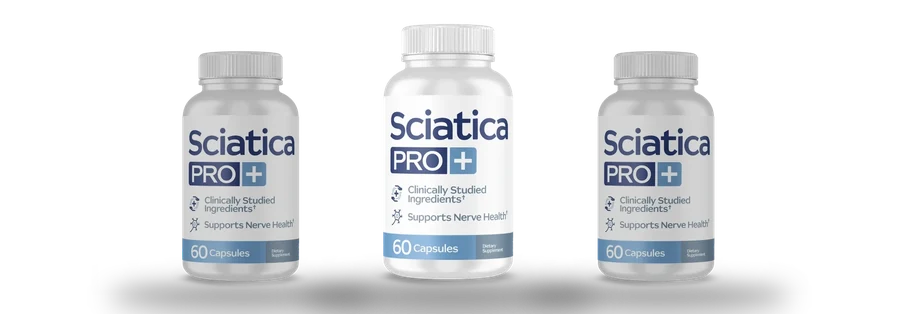
Sciatica Pro three-bottle pack render, 3 white bottles of 60 capsules
Price shown at the checkout read it there before you pay, and screenshot the page with the date

Shipping shown at the checkout 180 capsules · 90 days at two a day

  • Three bottles, 180 capsules in total
  • 90 days at two capsules a day
  • Two bottles are still sealed when the first one runs out
  • Price and shipping are read from the live checkout

Named as the most ordered

Six-Bottle Pack

360 capsules · 180 days

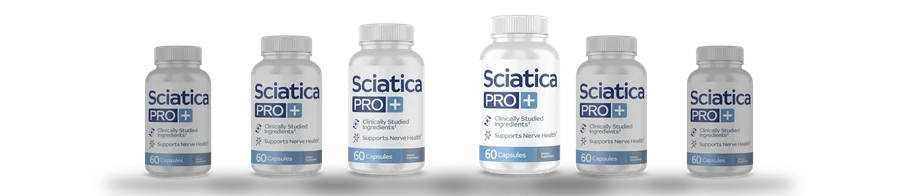
Sciatica Pro six-bottle pack render, 6 white bottles of 60 capsules
Price shown at the checkout read it there before you pay, and screenshot the page with the date

Shipping shown at the checkout 360 capsules · 180 days at two a day

  • Six bottles, 360 capsules in total
  • 180 days at two capsules a day
  • Five bottles are still sealed when the first one runs out
  • Price and shipping are read from the live checkout

No price was supplied to this desk and none is published here. The pack is explicit about it, in its own words: “Print live checkout prices. Do not guess.” That is the right instruction and this site follows it literally. Pack images exist for one bottle, three bottles and six bottles, so three pack sizes are offered. What each costs is printed on the checkout page and nowhere else, so that is where this site sends you for it: read the figure there, before you pay, and screenshot it with the date showing. A price you read yourself on the page that is about to charge you is worth more than one copied here and left to go stale.

One bottle: shown at the checkout60 capsules, two a day, thirty days a bottle. Ten ingredients, ten printed amounts, no proprietary blend.
Order Sciatica Pro

5.0 out of 10

The editorial scorecard

Eleven marks, each one a fact about the label rather than an opinion about the buyer. The highest and the lowest are both on this card for the same reason: the panel is good and the evidence behind it is thin.

5.0out of 10
Sciatica Pro editorial score
A printed amount for every ingredient10.0/10
The %DV arithmetic10.0/10
Label completeness8.5/10
Vitamin B6 restraint9.0/10
Front-of-bottle claim construction8.0/10
Amount against studied amount3.0/10
The product name, against 21 CFR 101.932.0/10
Evidence in the condition named1.0/10
Who you are buying from2.0/10
Price and guarantee transparency1.0/10
Reviews and social proof1.0/10
How each mark was reached. A low mark describes the label, never the person buying it.
What we scoredMarkWhy
A printed amount for every ingredient10.0/10Ten ingredients, ten printed amounts, no proprietary blend and nothing pooled. This is the highest mark on this card and it is not a courtesy: it is the difference between a label you can check and one you can only trust.
The %DV arithmetic10.0/10Four vitamin rows, four percentages, and all four correct — including folate, which needed a two-unit conversion first. 230 mcg folic acid times 400/240 is 383.3, printed as 383 mcg DFE, and 383 of 400 is 96%.
Label completeness8.5/10A full Supplement Facts panel with the plant part named on the botanical rows, a complete other-ingredients line, a caution paragraph, a storage line, a tamper-seal instruction, the FDA disclaimer, a no-added line, a lot code and a label revision. Little is missing from what it prints.
Vitamin B6 restraint9.0/101.7 mg, exactly 100% of the Daily Value, on the one ingredient where an excess causes nerve damage. The formulator could have printed fifty times this and still sat under the federal upper intake level. This is the best single decision on the label.
Front-of-bottle claim construction8.0/10Two claims, both structure/function, both daggered, with the disclaimer on the back. The front does not say the product treats, eases or relieves anything. That is the careful way to do it.
Amount against studied amount3.0/10Alpha lipoic acid at two-thirds of the studied optimum, benfotiamine at half the lower studied arm, acetyl L-carnitine at one thirtieth of the lowest studied dose — and every one of those studies was in diabetic neuropathy. Three fractions, all below one.
The product name, against 21 CFR 101.932.0/10The regulation defines a disease as damage to a part of the body such that it does not function properly, lists “The name of the product;” as a way a disease claim is made, and the product is named after a condition. No finding has been made by anybody; the mark reflects the question the name leaves open.
Evidence in the condition named1.0/10No trial cited anywhere in the supplied material studied sciatica. Every one was in diabetic neuropathy. Three of the ten ingredients have a federal consumer page that gives no amount for nerve pain at all.
Who you are buying from2.0/10Two companies, two states, two phone numbers. Ohio on the bottle, New York in the pack, and nothing supplied explains the relationship. A buyer who needs a refund has to guess which desk is theirs.
Price and guarantee transparency1.0/10No price, no pack total, no shipping cost, no guarantee length, no start point and no conditions were supplied. The pack’s own instruction — print live checkout prices, do not guess — is the right one, and it leaves a buyer reading this site unable to compare anything.
Reviews and social proof1.0/10Ten named reviews, a 4.7 score and a star split that averages 4.38, and nothing in the set ties any review to an order. None of it is published here as testimony.

18 The balance

What this label gets right, and what it does not

+What we rate

  • No proprietary blend. Ten ingredients, and every one of the ten carries its own printed amount on the Supplement Facts panel.
  • Every %DV on the panel is arithmetically correct — including folate, where the 230 mcg folic acid to 383 mcg DFE conversion had to be right first.
  • Vitamin B6 held at 1.7 mg, exactly 100% of the Daily Value, on the one ingredient where too much causes nerve damage.
  • The front of the bottle carries only structure/function claims, both daggered, with the FDA disclaimer printed on the back. That is the careful construction.
  • The plant part is named on all three botanical rows — root, leaf, root — and the capsule is declared as a vegetable capsule.
  • A real caution paragraph naming pregnancy, nursing, under-18s and any known medical condition, plus a storage line and a tamper-seal instruction.
  • A lot code, a certificate reference and a label revision are all printed, which is more traceability than many labels offer.
  • No painkiller, no stimulant and no sweetener in the formula, and the label makes no analgesic claim.
  • The pack’s own instruction to print live checkout prices rather than guess, which protects the buyer rather than the seller.

−What we do not

  • No trial cited anywhere studied sciatica. All three ingredient trials were in diabetic neuropathy — metabolic nerve damage, not nerve compression.
  • Alpha lipoic acid is 400 mg against the 600 mg SYDNEY 2 called optimal in diabetic distal symmetric polyneuropathy — two-thirds of it.
  • Benfotiamine is 150 mg against the 300 mg lower arm of a placebo-controlled trial in symmetrical distal diabetic polyneuropathy — half of it.
  • Acetyl L-carnitine is 50 mg against a lowest trial dose of 1,500 mg in diabetic peripheral neuropathy — one thirtieth of it.
  • Three rows at 25 mg have no federal amount for nerve pain at all — ashwagandha, broccoli and turmeric powders.
  • The product is named after a condition, and 21 CFR 101.93(g)(2)(iv)(A) lists “The name of the product;” as a way a disease claim is made.
  • Two different companies appear — Sciatica Pro+ of Akron, Ohio on the bottle, a New York office and returns address in the pack — and nothing explains the relationship.
  • No price, pack total, shipping cost or discount was supplied, so nothing on this site can tell you what it costs.
  • No guarantee length, start point or conditions were supplied — only a pointer to the live checkout.
  • Ten reviews, a 4.7 score and a split that averages 4.38, with nothing tying any review to an order. None of it is published here.

19 The FAQ

The questions people actually ask

Twelve of the hundred and fourteen on the full FAQ page.

Is Sciatica Pro legit?

It is a real product with an unusually good Supplement Facts panel: ten ingredients, ten printed amounts, no proprietary blend, and four percentages that are all arithmetically correct. What this desk would not stand behind is the marketing around it — ten reviews with nothing tying any of them to an order, a doctor-formulated roundel that names no doctor, and no price or guarantee supplied at all.

What are the ingredients in Sciatica Pro?

Ten, each with its own printed amount: vitamin D3 20 mcg, vitamin B6 1.7 mg, folate 383 mcg DFE (230 mcg folic acid), vitamin B12 2 mcg, alpha lipoic acid 400 mg, benfotiamine 150 mg, acetyl L-carnitine 50 mg, and ashwagandha, broccoli and turmeric powders at 25 mg each.

How much of each ingredient is in Sciatica Pro?

All ten amounts are printed on the panel and all ten are listed in the answer above. There is no proprietary blend, so nothing has to be derived, bounded or guessed at. That is the single most unusual thing about this label.

Does Sciatica Pro have a proprietary blend?

No. Every one of the ten rows carries its own figure and nothing is pooled into a total. Say that plainly, because it is rare: a blend prints one number for a group and leaves a reader unable to state any individual amount at all.

Is the %DV on the Sciatica Pro label correct?

Yes, on all four vitamin rows, and this desk checked each one. Vitamin D3: 20 of a 20 mcg Daily Value is 100%. Vitamin B6: 1.7 of 1.7 mg is 100%. Folate: 383 of 400 mcg DFE is 95.8%, printed as 96%. Vitamin B12: 2 of 2.4 mcg is 83.3%, printed as 83%.

Does Sciatica Pro work?

No trial of this formula has been published, so nobody can answer that from evidence — not this desk and not the seller. What exists is three ingredients with named trials, all of them in diabetic neuropathy, all of them at larger amounts than this label prints. No trial cited anywhere on this site studied sciatica.

Why do the trials not count for sciatica?

Because they were in a different condition and this site says so plainly rather than softening it. All three were in diabetic neuropathy, which is metabolic nerve damage. MedlinePlus: “Sciatica occurs when there is pressure on or damage to the sciatic nerve.” Compression is a different mechanism. That does not make the ingredients useless here — it makes them untested here.

How do I take Sciatica Pro?

Two capsules a day, with water. The label says “As a dietary supplement, adults take two (2) capsules daily. For best results, take with 6-8 oz of water or as directed by a healthcare professional.”

How much does Sciatica Pro cost?

No price was supplied to this desk, so none is printed on this site. The pack is explicit: “Print live checkout prices. Do not guess.” So the figure for one, three or six bottles is read at the checkout, which is the only page that can be charging you what it says. Read it before you pay and screenshot it with the date showing.

What are the side effects of Sciatica Pro?

None are published for this product, because no safety study of this formula exists. What is published belongs to individual ingredients. The one that matters most here is vitamin B6, and this label is restrained about it at 1.7 mg.

When should I stop taking it and call someone?

MedlinePlus Medical Encyclopedia prints the instruction as “Contact your provider right away if you have:” and the list includes “Loss of control of urine or stool (incontinence)”, fever with back pain, and weakness or numbness in the leg or pelvis. If any of those describes you, make the call today.

Is Sciatica Pro FDA approved?

No, and no dietary supplement is. FDA does not approve dietary supplements before they are marketed. The disclaimer printed on this bottle says the same thing in its own words: “THESE STATEMENTS HAVE NOT BEEN EVALUATED BY THE FOOD & DRUG ADMINISTRATION.”

All 114 questions, searchable

20 The sources

Sources for this page

  1. MedlinePlus, U.S. National Library of Medicine. Sciatica. medlineplus.gov. Accessed October 11, 2026.
  2. MedlinePlus Medical Encyclopedia, U.S. National Library of Medicine. Sciatica (Medical Encyclopedia). medlineplus.gov. Accessed October 11, 2026.
  3. National Institute of Neurological Disorders and Stroke. Back Pain. www.ninds.nih.gov. Accessed October 11, 2026.
  4. Electronic Code of Federal Regulations. 21 CFR 101.93 — Certain types of statements for dietary supplements. www.ecfr.gov. Accessed October 11, 2026.
  5. U.S. Food and Drug Administration. Structure/Function Claims. www.fda.gov. Accessed October 11, 2026.
  6. Ziegler D and others, Diabetes Care. Oral treatment with alpha-lipoic acid improves symptomatic diabetic polyneuropathy: the SYDNEY 2 trial. pubmed.ncbi.nlm.nih.gov. Accessed October 11, 2026.
  7. Stracke H and others, Experimental and Clinical Endocrinology & Diabetes. Benfotiamine in diabetic polyneuropathy (BENDIP): results of a randomised, double-blind, placebo-controlled clinical study. pubmed.ncbi.nlm.nih.gov. Accessed October 11, 2026.
  8. Cochrane Database of Systematic Reviews. Acetyl-L-carnitine for the treatment of diabetic peripheral neuropathy. www.cochrane.org. Accessed October 11, 2026.
  9. NIH Office of Dietary Supplements. Vitamin D — Consumer. ods.od.nih.gov. Accessed October 11, 2026.
  10. NIH Office of Dietary Supplements. Vitamin B6 — Consumer. ods.od.nih.gov. Accessed October 11, 2026.
  11. NIH Office of Dietary Supplements. Folate — Consumer. ods.od.nih.gov. Accessed October 11, 2026.
  12. NIH Office of Dietary Supplements. Vitamin B12 — Consumer. ods.od.nih.gov. Accessed October 11, 2026.
  13. U.S. Food and Drug Administration. Health Fraud Scams. www.fda.gov. Accessed October 11, 2026.
  14. U.S. Food and Drug Administration. FDA 101: How to Use the Consumer Complaint System and MedWatch. www.fda.gov. Accessed October 11, 2026.
  15. Federal Trade Commission. Report Fraud to the FTC. reportfraud.ftc.gov. Accessed October 11, 2026.

Order Sciatica Pro from the official page

60 capsules a bottle, two capsules a day, thirty days a bottle. Ten ingredients and ten printed amounts, about 677 mg of declared actives a serving, and no proprietary blend anywhere on the panel. The price, the shipping and the guarantee are read from the live checkout, because none of the three was supplied to this desk. Order support +1 (302) 200-3480.

Price and guarantee are read on the checkout page — screenshot it with the date before you pay · ships from inside the US · order support +1 (302) 200-3480

What this page was checked against

Three sources, and a review slot

  • The photographed bottle — the Supplement Facts panel, the other-ingredients line, the warning panel and the disclaimer box.
  • The material the seller supplied with this product, reported as the seller’s and labelled as such wherever the two disagree.
  • Federal and published sources at MedlinePlus, NINDS, NIH ODS, FDA, FTC, the eCFR, PubMed and Cochrane, opened and read on .

Every figure on this page is either printed on the label or derived from what is printed, with the derivation shown beside it. The medical review sits in the block alongside.

Editorial standards · How a fact gets onto a page here

Medical review Dr. Julia Buchfuhrer

Who wrote this page, and who reviews it

Written by
The Mysciaticapro editorial desk — the desk that reads the bottle, the supplied pack and the federal pages.
Medically reviewed by
Dr. Julia Buchfuhrer, MD, Physician
Role
Medical reviewer
Review date
October 12, 2026

A slot stays marked until a real person fills it. Nothing on this site is signed by anybody who has not read it. Who reviews these pages?

Sciatica Pro — 60 capsules, two a day 30 days a bottle · price and guarantee shown at the checkout